Page 1 of 6
Books and Reading
Posted: January 5th, 2019, 11:46 pm
by Joblom
I don't see a thread here for book recommendations. Surely the lot of you do read from time to time. I can't remember if there was a book thread on the BSN Clan Zorah. I've been reading a lot the last few years. Though I have slowed down the last nine months or so since finally giving in to culture and buying a smart phone. Since then I've learned to appreciate audiobooks while I work during the day. It's a lot easier than trying to absorb novels in 10 minute breaks and about half an hour on my lunches.
Mostly I've read a lot of science fiction. I started with Animorphs and Goosebumps as a kid and moved on to Stephen King and Michael Crichton in my teens. In my adult life I've read lots and lots of science fiction by a whole host of authors. It was some recent audiobooks that brought me back to Mass Effect recently, in fact.
In this thread I'll list some of my favorites with a brief synopsis of each and my thoughts on the book. I will discuss spoilers too, but I'll block those with tags in case you don't want to have anything revealed. I figure the rest of you might do the same in this thread.
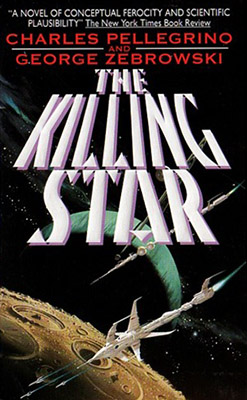
This is a must read for any fan of hard science fiction. Albeit I must warn you the books tone not uplifting. Its' a very cynical book about aliens attacking humanity with overwhelming force and the survivors struggling to survive. The authors raise a lot of thought provoking and chilling questions about the nature of life in the universe and the evolution of intelligence, as well as the speculative psychology of a space faring species. The authors are not Gene Roddenberry or Carl Sagan. There is another book that works as a sort of prequel to it called "Flying to Valhalla". It is not as well known but is also very good, taking place on a much smaller scale in the same universe and restating the primary concepts of "The Killing Star" in a different way.
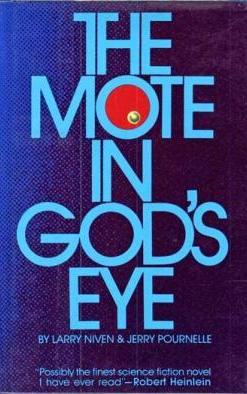
A classic that I'm curious to see put to film someday... or would be. Frankly I am skeptical that modern film makers would do the story justice. "The Mote In God's Eye" is a one off novel that takes place in a previously established setting but you don't need to know anything about the expanded universe to understand anything happening in this story. In fact, I've never read any of the other books, or its sequel (which I heard bad things about) but this novel remains one of my favorites.
The premise is a space-faring human civilization making contact with an alien race for the first time. This is not treated as any trivial affair with the story following the logical and methodical approach to this momentous occasion in great detail. The aliens are fascinating and memorable and I think that if you will discover they were possibly the inspiration for one of Mass Effect's primary species. Shades of grey are found all throughout the story in its plot and characters. It touches on some issues that are also brought up in "The Killing Star" in regards to species motivation and 'international' or in this case, interstellar, relations. I think that anyone studying international relations in school ought to read this.
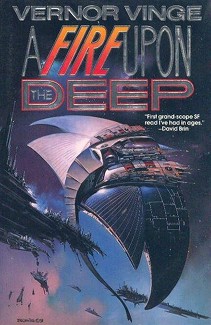
By Vernor Vinge, "A Fire Upon the Deep" is a very creative, fun, emotional, and disturbingly predictive tale about a fantastic universe that is both soft and hard science fiction at the same time. Though this might appear to be a contradiction Vinge's universe actually makes sense once this feature is explained. The most interesting aspect of this is that spaceship design in the novel must incorporate laws of the universe that do and do not allow for faster than light travel. This book can also be a bit of a challenge at first because the first aliens you meet are quite alien indeed and it took me a few pages to figure out just what the hell was being described to me. It has some prequels and a sequel, but I haven't read them.
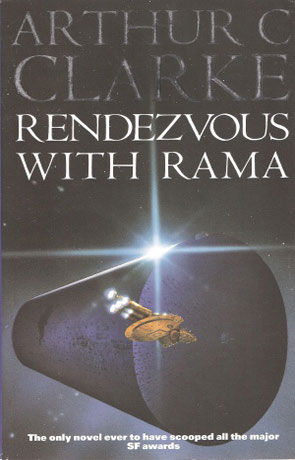
This is easily my favorite story by Arthur C. Clarke and it might even be my favorite novel period. An alien craft is discovered traversing the solar system and will eventually pass through and be lost forever. Before it leaves an expedition is sent to explore and catalog it. What I love about this story is that it reads somewhat like a mystery with each chapter unfolding and you learning something new. However each revelation is never what you expected, leaving you with yet more questions. Despite that, it becomes apparent that the author is not just throwing out random ideas without any concept of how they fit together; you can start to figure things out if you pay attention and think hard and are familiar with the concepts of interstellar travel, futurism, and such. There are sequels but they were written with a co-author and I do not recommend them. They forgo the exploration and mystery of the first novel in favor of petty human drama.
(I will list some other books in another post in the near future)
Re: Books and Reading
Posted: January 6th, 2019, 12:00 am
by Vol
I just finished "The Death of WCW" today. It's a history of the rise of professional wrestling into the 90s explosion, how WCW peaked with the nWo stable, then the ugly, painful decline into death early in the new millennium. I was a huge wrestling fan as a child, but always preferred WWF, and I only had anecdotes over the years of how stupid WCW became towards the end. Edifying, but sad, because a lot of the jackasses that ruined the company still have jobs in other wrestling companies. Worth a read if you care about pro wrestling history at all. It truly was madness towards the end. Blowing millions on live music acts that only hurt ratings, celebrities that wouldn't show up to practice before matches, paying for every man on the roster to get plane tickets for every show despite using a fraction at any given one.
Before that, I read "Onward Towards Our Noble Deaths," a classic Japanese work by an Imperial Japanese army veteran. Old manga style, details a slightly fictional story of what he went through during the island campaigns as the US was invading. Short, as it's visual, but humanizes the Japanese effort very well, while showing how the remnants of bushido were still active. Nice parallel in how the higher officers act like what one might imagine an uptight dickhead officer on our side to be, only with more serious consequences to their philosophy.
And before that, knocked out The Turner Diaries while preparing for my colonoscopy. It seemed rather thematically fitting. It's about the fictional diary of a man who's part of a semi-secret neo-Nazi militia, though they never actually refer to Nazis by name. As the resistance gets more bold, the fed get more overt in cracking down, and to the dismay of the militia, the American people do not rise up in revolt as draconian measures are taken to suppress the very small movement. So they turn to terrorism, killing journos, Jews, blacks, the usual suspects, government cracks down even harder, raids for weapons, yada yada, eventually escalates to full scale civil nuclear war for the purpose of establishing a pure white America. There was one rather good point in all of it, and that was that the protagonist realized that conservatives were content to complain and make tiny steps towards their agenda, but would never, ever be roused to fight for it, nor would Americans ever find their revolutionary spirit en masse, no matter how bad life got. That much is true. The rest is Nazi fan-fiction, but the prose was decent, and it was entertaining enough to finish while dealing with multiple laxatives rampaging through my guts.
Re: Books and Reading
Posted: January 6th, 2019, 12:12 am
by Joblom
Vol wrote:There was one rather good point in all of it, and that was that the protagonist realized that conservatives were content to complain and make tiny steps towards their agenda, but would never, ever be roused to fight for it, nor would Americans ever find their revolutionary spirit en masse, no matter how bad life got. That much is true. The rest is Nazi fan-fiction, but the prose was decent, and it was entertaining enough to finish while dealing with multiple laxatives rampaging through my guts.
I've heard it said that conservatives are honorable losers.
I've heard of the Turner Diaries and I know what it's about but I've never read it. Oddly enough, a few months ago I read a book by LeVar Burton (Reading Rainbow and Star Trek fame) called "Aftermath". It is set in a post-apocalyptic America after natural disasters and a race war tore the country apart. It was an... interesting read. It was definitely not what I was expecting and I think if more people were aware of it that LeVar would get some heat. It's definitely not PC. I had no idea what it would be about when picked up at the used book store. It was described as being Burton's twist on Stephen King's "The Stand". It's not really that though. A little heavy-handed and I find the message to be well intention-ed but... flawed in its thinking and messaging.
I've never cared about Professional Wrestling but I think the rise and fall of any industry can be a compelling read.
Regarding "Onward Towards Our Noble Deaths" I have been trying to read more non fiction lately. Not into the manga style, but none the less that gives me an idea of some non fiction book topics to look into.
Re: Books and Reading
Posted: January 6th, 2019, 12:58 am
by TheodoricFriede
Pretty sure you just made Raga's day, because she has been talking about making a book thread forever.
Re: Books and Reading
Posted: January 6th, 2019, 5:48 am
by Alienmorph
This is actually a pretty good idea!
As for me, currently I'm reading through the Uplift Saga:
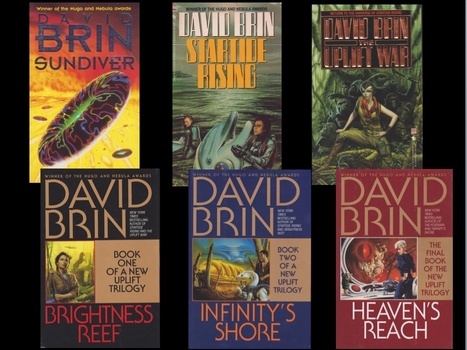
It's a space opera kind of thing, set in a universe where naturally evolved civilizations are incredibly rare (one every billion year or two) but there's still a vibrant galactic community in all the galaxies of the Local Cluster because the last natural civilization made an habit of uplifting lifeforms on the brink of sentience, creating numerous other civilizations. A practice that continued for millions of years, and to who humans are partecipating too, by creating space-faring apes and dolphins. So you do get the usual space opera feel, but most of the main characters, including many of the aliens, are essentially super-intelligent animals, and even plants in a few cases.
I'm currently halfway through the second book, Startide Rising, and I have the two trilogies the saga is made of collected into two nice Ominbuses edition. Pretty cool stuff so far, but it's taking me longer than usual to read through this, because the italian edition was nigh-impossible to find, so I had to go for english, and so I'm taking it in small burst.
Re: Books and Reading
Posted: January 6th, 2019, 11:05 pm
by Joblom
Alienmorph wrote:This is actually a pretty good idea!
As for me, currently I'm reading through the Uplift Saga:
It's a space opera kind of thing, set in a universe where naturally evolved civilizations are incredibly rare (one every billion year or two) but there's still a vibrant galactic community in all the galaxies of the Local Cluster because the last natural civilization made an habit of uplifting lifeforms on the brink of sentience, creating numerous other civilizations. A practice that continued for millions of years, and to who humans are partecipating too, by creating space-faring apes and dolphins. So you do get the usual space opera feel, but most of the main characters, including many of the aliens, are essentially super-intelligent animals, and even plants in a few cases.
That does sound interesting and I think I've heard of it. Is it in audiobook form? A friend of mine was telling me about a series he loves. That might have been it.
Re: Books and Reading
Posted: January 7th, 2019, 5:15 am
by Alienmorph
I dunno, I don't listen to many audiobooks, I prefer reading "old school" lol
But it's a series that's been around for a while, so I wouldn't be surprised if there are audiobooks.
Re: Books and Reading
Posted: January 7th, 2019, 11:10 am
by Raga
I am an audiobook listening fool. I mentioned in the main thread a while back that I figured out a few months ago that giant open-world games lend themselves to listening to audiobooks while you play. Shooting goblins or traveling from point A to point B only requires like 25% brainpower, and I just pause the audiobook when I get to cutscenes or dialog or something of substance.
I'm on Goodreads if anybody wants to be friends on there. PM if so because I use my real name on that website.
The last couple of books I read were horror, modern classics.

Since sci-fi seems to be on the table, the main sci-fi I read last year:
Remembrance of Earth's Past Trilogy by Cixin Liu
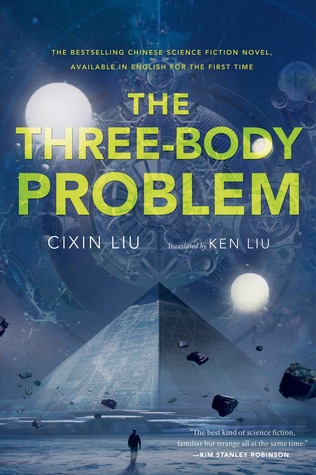
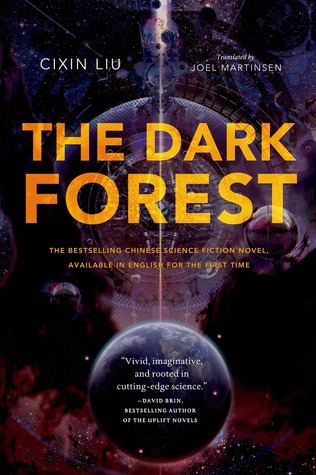
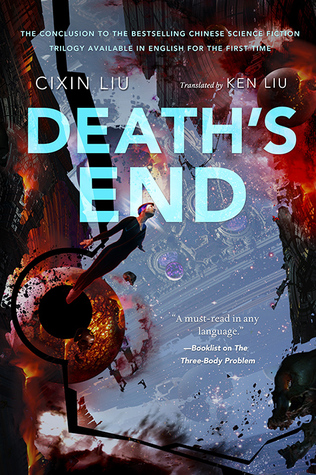
This series is written by a Chinese author and poses a super-dark answer to the Fermi Paradox. It's quite good but the translation definitely makes it a clunky sort of read.
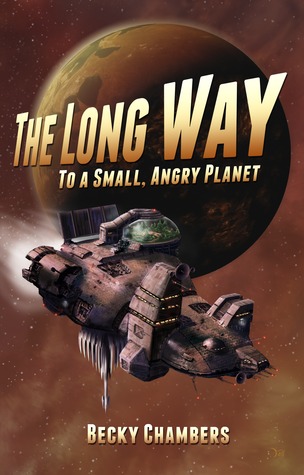
Tried it and found it to be hot garbage. I couldn't even finish it. So not a Hugo worthy series.
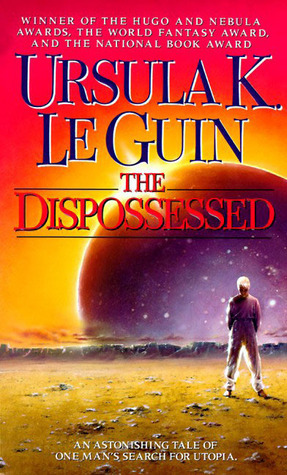
Some distant cousins of humans set up an anarchist "utopia" on the moon of a distant world. This is "anthropological sci-fi" which is to say that the "science" part focuses on social science and not on hard science. This tends to be my favorite kind of sci-fi. I love Ursula K. LeGuin but I think her fantasy books tend to be better than her sci-fi.
And finally some classics, all of which I enjoyed:


I'm currently getting caught completely up on a favorite popcorn fiction writer of mine Michael Sullivan. He writes unapologetic sword and sorcery stuff. He's not going to win any awards but I've consistently loved his stuff.
Next up sci-fi wise is The Expanse series and/or A Canticle for Leibowitz.
Next up fantasy wise is the Malazan series.
I'll leave off rambling about nonfiction for now. I've started reading a lot of political stuff lately, but I normally read mostly history and science stuff.
Re: Books and Reading
Posted: January 7th, 2019, 10:26 pm
by Joblom
I will have to give some of these a read (or listen) in the future. I read the Moon Is a Harsh Mistress early last year. I'd say it qualifies as a political book. A "Rules for Radicals" for science fiction nerds I suppose.
Re: Books and Reading
Posted: January 8th, 2019, 9:21 am
by Raga
Sure, but when I call a book "political" I mean something like, say, Civil Disobedience by Henry David Thoreau and not just a novel with political themes or even political didacticism. "Idea" oriented science-fiction is my favorite. I pretty much never read popcorn sci-fi (which is what the Becky Chambers book was). It's arguably the most philosophical fiction genre out there.
Re: Books and Reading
Posted: January 8th, 2019, 9:40 pm
by Joblom
Raga wrote:Sure, but when I call a book "political" I mean something like, say, Civil Disobedience by Henry David Thoreau and not just a novel with political themes or even political didacticism.
...and I would say the Moon Is a Harsh Mistress is political. It's a fictional setting, but it could be used as a teacher too.
Re: Books and Reading
Posted: January 9th, 2019, 9:31 am
by Raga
Another sci-fi book from last year that I read but forgot to mention:
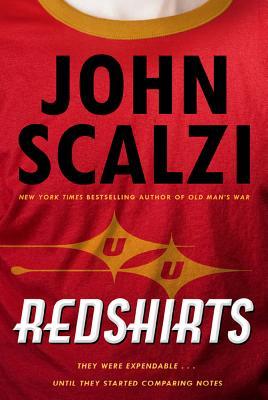
This is a Star Trek parody as can probably be guessed by the name. Some people on an exploratory spaceship don't understand why certain people on the ship can live through anything and other people die in droves at the drop of a hat, and then realize with slowly dawning horror that they are the characters in a badly written Star Trek knockoff TV show and they aren't the main characters so they are expendable.
This premise is so stupid it shouldn't work, but it totally does. It does have a weirdly serious series of epilogues about the writer of the TV show which I didn't think added anything to the rest of the book.
Re: Books and Reading
Posted: January 20th, 2019, 11:29 pm
by Sinekein
I've been reading Sophie Hannah's Poirot books - The Monogram Murders and Open Casket. Tried it because she's the one who got the authorization to officially use the character of Hercule Poirot, and I am a huge Poirot and Christie fan.
They're quite alright. One of the main strengths is that like Christie's, they are fair play whodunnits, where the reader gets a real shot at identifying the murderer. And Poirot's character is faithfully adapted, he's still as vain and entertaining as he has ever been. The duo he makes with the new Inspector Catchpool works quite well, and Catchpool has a bit more depth than Hastings had - he's more actively involved in the investigations, being a Scotland Yard member.
However, there is one thing that Hannah hasn't quite mastered like Christie yet (but who has really?), it's establishing the setting. Especially in the early pages, the exposition feels really forced and dialogue unnatural - it gets better once the story gets going, but it is really obvious early on. When Christie wrote, the set was always crafted in an organic way, like a puzzle where each piece perfectly fit to create the starting situation, before the murder happens.
Also, character traits can at times feel a bit exaggerated. Like a character who is a young, rich woman with a nasty tongue who can't go one sentence without insulting someone. Christie would have probably used the "less is more" approach, by focusing on a couple of "key" insults, so that the reader can come to the conclusion, again, in a more organic way.
Still good reads. You can't really translate Poirot's psychological approach in a more modern setting, because crime scene science would have to take precedence. So there isn't really anyone better than Poirot for that - and he would obviously know it himself.
Re: Books and Reading
Posted: January 21st, 2019, 12:26 am
by Vol
I'm slowly working through Adjustment Day, by Chuck Palahniuk. It's the socioeconomical version of Fight Club, more or less. Congress is planning to start a massive war in the Middle East to allow the draft to be reinstated so they can bleed off the excess males in America. Instead, through a rather twisted, arcane system, the revolution finally comes, and results in America split into 3 nations. One for the whites, one for the blacks, and one for the homosexuals. Of course this all smeared in Palahniuk's style of "optimistic grime," wherein he'd use the metaphor of finding an 800mg oxycotin on the shit, piss, and cum smeared floor of a men's restroom to make a point about bettering society.
So far, Gaysia seems to be cosmopolitan NYC more or less, but infiltrated by interracial couples feigning gay in order to stay together. Caucasia immediately reverted to a feudal system of kings and castles, giving up the pursuit of progress and science so the white race can "catch it's breath" and have some babies. The black land is the focus of the chapter I just began, but it starts with, apparently, them becoming a scientific powerhouse as the best and brightest minds of the black race are no longer on a labor strike (Since slavery began in earnest).
It's a fun mix of absurdist comedy, "optimistic grime," and politics. No idea where it's going!
Re: Books and Reading
Posted: January 21st, 2019, 2:35 am
by Raga
Sinekein wrote:I've been reading Sophie Hannah's Poirot books - The Monogram Murders and Open Casket. Tried it because she's the one who got the authorization to officially use the character of Hercule Poirot, and I am a huge Poirot and Christie fan.
They're quite alright. One of the main strengths is that like Christie's, they are fair play whodunnits, where the reader gets a real shot at identifying the murderer. And Poirot's character is faithfully adapted, he's still as vain and entertaining as he has ever been. The duo he makes with the new Inspector Catchpool works quite well, and Catchpool has a bit more depth than Hastings had - he's more actively involved in the investigations, being a Scotland Yard member.
However, there is one thing that Hannah hasn't quite mastered like Christie yet (but who has really?), it's establishing the setting. Especially in the early pages, the exposition feels really forced and dialogue unnatural - it gets better once the story gets going, but it is really obvious early on. When Christie wrote, the set was always crafted in an organic way, like a puzzle where each piece perfectly fit to create the starting situation, before the murder happens.
Also, character traits can at times feel a bit exaggerated. Like a character who is a young, rich woman with a nasty tongue who can't go one sentence without insulting someone. Christie would have probably used the "less is more" approach, by focusing on a couple of "key" insults, so that the reader can come to the conclusion, again, in a more organic way.
Still good reads. You can't really translate Poirot's psychological approach in a more modern setting, because crime scene science would have to take precedence. So there isn't really anyone better than Poirot for that - and he would obviously know it himself.
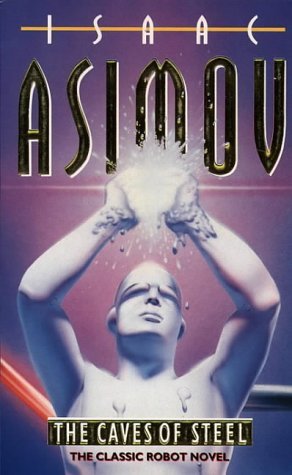
If you like Christie, you might like those Isaac Asimov robot novels I linked earlier. They are sci-fi mysteries that he wrote because some person told him that sci-fi couldn't be cross genre or something dumb like that. Agatha Christie was one of his favorite authors and he explicitly modeled her.
I've only read And Then There Were None, but I really liked it. I've been meaning to read some more.
Re: Books and Reading
Posted: January 21st, 2019, 9:19 am
by Sinekein
Raga wrote:
If you like Christie, you might like those Isaac Asimov robot novels I linked earlier. They are sci-fi mysteries that he wrote because some person told him that sci-fi couldn't be cross genre or something dumb like that. Agatha Christie was one of his favorite authors and he explicitly modeled her.
Noted, I have a couple of nonfiction books first, but then I think I'll give those a try.
Raga wrote:I've only read And Then There Were None, but I really liked it. I've been meaning to read some more.
It's probably the greatest. If you managed to stay away from any spoiler regarding their solutions, I would suggest Murder on the Orient Express, Death on the Nile, The Murder of Roger Ackroyd, Cards on the Table (must be read after Orient Express) or The ABC Murders. Plus, if you read several Poirot novels already, Curtain.
Re: Books and Reading
Posted: January 21st, 2019, 1:07 pm
by magnuskn
I can recommend the Dresden Files to everybody. They start off being okay and get better with every book. Not a mean feat, considering the inverse seems to be true with many other authors.
Re: Books and Reading
Posted: January 22nd, 2019, 2:53 am
by NCLanceman
Vol wrote:It's a fun mix of absurdist comedy, "optimistic grime," and politics. No idea where it's going!
I'm trying to imagine the entire paragraph before that sentence being "fun". It's not an easy feat.
Off and on over the past year I've been working on Appendix N. Appendix N, for those who don't know, is the note at the end of the AD&D Dungeon Master's Guide and reads like this:
APPENDIX N: Inspirational and Educational Reading wrote:Inspiration for all the fantasy work I have done stems directly from the love my father showed when I was a tad, for he spent many hours telling me stories he made up as he went along, tales of cloaked old men who could grant wishes, of magic rings and enchanted swords, or wicked sorcerors and dauntless swordsmen. Then too, countless hundreds of comic books went down, and the long-gone EC ones certainly had their effect. Science fiction, fantasy, and horror movies were a big influence. In fact, all of us tend to get ample helpings of fantasy when we are very young from fairy tales such as those written by the Brothers Grimm and Andrew Lang. This often leads to reading books of mythology, paging through bestiaries, and consultation of compilations of the myths of various lands and peoples. Upon such a base I built my interest in fantasy, being an avid reader of all science fiction and fantasy literature since 1950. The following authors were of particular inspiration to me. In some cases I cite specific works, in others, I simply recommend all of their fantasy writing to you. From such sources, as well as any other imaginative writing or screenplay, you will be able to pluck kernels from which will grow the fruits of exciting campaigns. Good reading!
Anderson, Poul: THREE HEARTS AND THREE LIONS; THE HIGH CRUSADE; THE BROKEN SWORD
Bellairs, John: THE FACE IN THE FROST
Brackett, Leigh
Brown, Fredric
Burroughs, Edgar Rice: “Pellucidar” series; Mars series; Venus series
Carter, Lin: “World’s End” series
de Camp, L. Sprague: LEST DARKNESS FALL; THE FALLIBLE FIEND; et al
de Camp & Pratt: “Harold Shea” series; THE CARNELIAN CUBE
Derleth, August
Dunsany, Lord
Farmer, P. J.: “The World of the Tiers” series; et al
Fox, Gardner: “Kothar” series; “Kyrik” series; et al
Howard, R. E.: “Conan” series
Lanier, Sterling: HIERO’S JOURNEY
Leiber, Fritz: “Fafhrd & Gray Mouser” series; et al
Lovecraft, H. P.
Merritt, A.: CREEP, SHADOW, CREEP; MOON POOL; DWELLERS IN THE MIRAGE; et al
Moorcock, Michael: STORMBRINGER; STEALER OF SOULS; “Hawkmoon” series (esp. the first three books)
Norton, Andre
Offutt, Andrew J.: editor of SWORDS AGAINST DARKNESS III
Pratt, Fletcher: BLUE STAR; et al
Saberhagen, Fred: CHANGELING EARTH; et al
St. Clair, Margaret: THE SHADOW PEOPLE; SIGN OF THE LABRYS
Tolkien, J. R. R.: THE HOBBIT; “Ring trilogy”
Vance, Jack: THE EYES OF THE OVERWORLD; THE DYING EARTH; et al
Weinbaum, Stanley
Wellman, Manley Wade
Williamson, Jack
Zelazny, Roger: JACK OF SHADOWS; “Amber” series; et al
The most immediate influences upon AD&D were probably de Camp & Pratt, R. E. Howard, Fritz Leiber, Jack Vance, H. P. Lovecraft, and A. Merritt; but all of the above authors, as well as many not listed, certainly helped to shape the form of the game. For this reason, and for the hours of reading enjoyment, I heartily recommend the works of these fine authors to you.
– E. Gary Gygax, December 1979, AD&D Dungeon Masters Guide, p. 224
There's a rather excellent book on
Appendix N based on
a series of blogposts I highly recommend to anyone interested in how D&D became D&D. PROTIP: Tolkien had just about nothing to do with how D&D got formed.
In any case, once I started reading these books, it rather clearly showed me that the fantasy I'd read before was nothing compared to the old masters. In particular, Robert E. Howard's Conan has yet to see a version on screen that holds a candle to the actual stories he wrote. Poul Anderson's "Three Hearts, Three Lions" is essentially PALADIN: THE BOOK, and if it doesn't stir your heart with rip-rollicking adventure, I don't know what will. "The Broken Sword", also by Poul Anderson is everything I wanted from the Song of Ice and Fire books, in a concise, entertaining, volume that didn't waste my time because the author got bored when he couldn't torture the characters anymore and had to move the plot along.
Sorry, if I had to make an anti-recommendation, it's the Ice and Fire Books. They're godawful, soul-killing dreck and I would rather have dental surgery than read another one of these books. Fuck that guy, the TV show's better in every respect.
Of particular note is Leigh Brackett's "The Sword of Rhiannon" and Roger Zelazny's "Amber" series. Those two stand out as being...
fantastic in a way that fantasy really hasn't been after Tolkien.
I'm continuing to read as I go, right now I'm working on the Fafherd and the Grey Mouser series. So far, at least, I'm looking forward to more!
Re: Books and Reading
Posted: January 22nd, 2019, 4:13 pm
by Raga
NCLanceman wrote:In any case, once I started reading these books, it rather clearly showed me that the fantasy I'd read before was nothing compared to the old masters.
The history of fantasy is like a pet fetish of mine. It's bizarre in that according to who you ask or how you define it, fantasy is either the oldest form of story known to man or one of the newest.
There are broadly three big strains of it. One starts more or less with George MacDonald in the late 1800s and is basically a mixing of classical elements of mythology with modern religious themes. This path points to C. S. Lewis and Tolkien and is a major root of modern high fantasy. These dealt almost exclusively with "high" myth modeled on things like Greek mythology, the Prose Edda, & Beowulf. Their model is the epic and their theme is dealing with the numinous.
The second basically originates in the pulps at the turn of the century (Conan type stuff as you already mentioned) and maintained an almost entirely separate evolution from high fantasy until the 1970s or later. This path points both to Dungeons & Dragons (though there is some high fantasy root there as well) and to modern sword and sorcery.
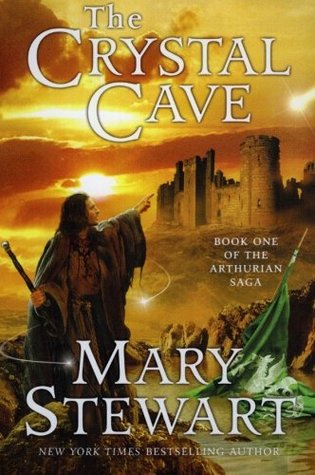
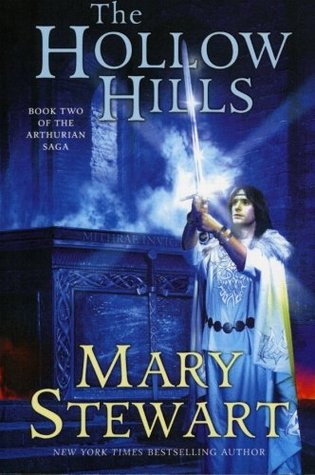
Meanwhile, there was another current in the mid part of the 20th century consisting of a bunch of "YA" authors (a lot of whom were women) who didn't write obviously YA materials, but who were often relegated to YA because publishing at that time was basically of the opinion "Oh, dragons and wizards? It must be a children's book!" This includes series such as the Earthsea Trilogy by Ursula K. Le Guin, The Dark is Rising by Susan Cooper, the Prydain Chronicles by Lloyd Alexander, the books of Robin McKinley, the books of Dianna Wynne Jones, and others. These differ markedly from "high fantasy" in that the source material they mine is much more likely to be the stories of "folk." They deal in the lesser known and the less high brow - folktales and fairy stories. (Though they do tend to go way more in for Arthurian myths than high fantasy, which can be sort of high brow - the Merlin trilogy by Mary Stewart as one example). They are also disproportionately more likely to have wizards for main characters and are one of the chief reasons it became okay to have wizards be something besides villains or Gandalf type mentor characters.
These went along their separate ways for the most part only tentatively starting to blend in the 1980s and not going for full broke until the last 20 years.
I go out of my way to read old fantasy, not so much because it's better (though it often is), but just to fill in more holes in the puzzle of how it evolved.
For anybody interested in getting a foothold:
Tales Before Tolkien is a good starter-pack anthology for this kind of stuff.
Also, one of my favorite things on the subject:
On Fairy Stories By Tolkien. It contains my favorite quote "I desired dragons with a profound desire" which in context always gives me chills.
Re: Books and Reading
Posted: January 22nd, 2019, 5:29 pm
by Joblom
Sinekein wrote:They're quite alright. One of the main strengths is that like Christie's, they are fair play whodunnits, where the reader gets a real shot at identifying the murderer. And Poirot's character is faithfully adapted, he's still as vain and entertaining as he has ever been. The duo he makes with the new Inspector Catchpool works quite well, and Catchpool has a bit more depth than Hastings had - he's more actively involved in the investigations, being a Scotland Yard member.
I should try some good mystery novels, ones that really do give you a chance to figure things out ahead of time. Do you have other recommendations?
Re: Books and Reading
Posted: January 22nd, 2019, 7:00 pm
by Vol
NCLanceman wrote:I'm trying to imagine the entire paragraph before that sentence being "fun". It's not an easy feat.
Off and on over the past year I've been working on Appendix N. Appendix N, for those who don't know, is the note at the end of the AD&D Dungeon Master's Guide and reads like this:
It's not grim or brutal in the way The Turner Diaries was, or other novels in the vein of "The revolution has finally come" probably are. It's cartoonish, almost. In the prelude to the great slaughter, workers all over the country are digging these gigantic holes all over the place, in universities, in the capital, for the disposal of bodies, but no one stops to ask them about it or suss out their purpose. The whites set up _medieval courts_ as soon as they set up their homeland, and the POV we get of one of the new kings is him trying to find an Aryan queen. His first choice, after going through many sessions of peasant girls showing off their bests, is a white-passing latina.
As opposed to a story such as Transmetropolitan, where the grime is unpleasant and constant.
Re: Books and Reading
Posted: January 22nd, 2019, 7:13 pm
by NCLanceman
Raga wrote:These went along their separate ways for the most part only tentatively starting to blend in the 1980s and not going for full broke until the last 20 years.
I go out of my way to read old fantasy, not so much because it's better (though it often is), but just to fill in more holes in the puzzle of how it evolved.
Alas, I only have the answer to the last bit of how it evolved. And the simple answer is the one-two punch of post-War ideas of modernity set in, followed by Dungeons and Dragons itself. Gygax and Arneson only intended D&D to be a toolbox for which you could build your own settings, since the game was created by a bunch of nerds for whom Appendix N was a list of books everyone knew.
After D&D, two things happened. First,
Thor Power Tool vs. The Commissioner of Internal Revenue kicked in. You'll note that Appendix N was written in 1979. That year, that case went through and changed the way book publishing worked. It used to be that you could walk into any book store and find the books on that list. Nowadays, since the IRS can charge taxes on unsold stock, book publishers -and thus, book stores- don't have new books sitting next to the old masters anymore, unless the old masters are continually massively profitable. I.E. Tolkien. Which is how in spite of their excellent quality, somehow Anderson, Brackett (wrote the first draft of Empire Strikes Back, dammit!), Zelazny, Vance, and Abraham Merritt fell by the wayside.
Second, you got a whole generation of fantasy writers who didn't know the classics, but did know D&D. As I said, D&D wasn't meant to be a whole setting, it's meant to be a toolbox. But of course the first big business decision after Lorraine Williams became the CEO of TSR was to push a bunch of settings that used
all of the stuff in the Monster Manual. So, without the old masters on shelves for comparison and ten million Dragonlance novels on the other side, here we are today. And that's how fantasy novels from then to now stopped being
fantastic.
With a few exceptions, at least. Jim Butcher, last I checked, is the only guy doing cool things in the urban fantasy genre, and it's definitely because he remembers what fairies and elves were when Lord Dunsany was writing.
Re: Books and Reading
Posted: January 24th, 2019, 10:01 am
by Raga
I just finished Altered Carbon, which is only the second cyberpunk book I've ever read, the other being Neuromancer. Neuromancer is certainly the "purer" of the two in genre terms and is probably the best in terms of craft, but I enjoyed them about the same amount (roughly 4 out 5 stars). Altered Carbon is actually cleaner than a lot of cyberpunk which is usually dirty in literally every sense: physically, morally, aesthetically, & philosophically. It also serves pretty well as a mystery story as a kind of hybrid between a technothriller and a police procedural as the plot centers around solving a murder so even for people who don't usually go in for cyberpunk, it's quite readable.

I have since started The Curse of Chalion by Lois McMaster Bujold, which is the first of her novels I've tried. I'm about 4 hours into the audiobook and liking it so far. It appears to be that species of high fantasy I like best, which is situated exactly halfway between cookie-cutter Tolkien clone goody-two-shoeness and the dark, wanton silliness of what I call "grimdark Disney" stuff like ASoIaF (meaning that it's as formulaic and predictable as the Disney type stories it tries to subvert because it always chooses to do the opposite of what the goody-two-shoes stories would do). Supposedly, it's loosely inspired by the history of Spain in the era of Catherine of Aragon.

I had actually intended to start a couple of series next, but I decided to clean out some of the stuff that had been setting around on my to-read list the longest instead and this one had been on there for nearly 3 years.
This particular book can be read on its own, but I'm liking it enough so far that I'll probably read more books in the series or some of her sci-fi stuff at some later point.
Re: Books and Reading
Posted: January 24th, 2019, 11:37 am
by Sinekein
Raga wrote:I
I have since started The Curse of Chalion by Lois McMaster Bujold, which is the first of her novels I've tried. I'm about 4 hours into the audiobook and liking it so far. It appears to be that species of high fantasy I like best, which is situated exactly halfway between cookie-cutter Tolkien clone goody-two-shoeness and the dark, wanton silliness of what I call "grimdark Disney" stuff like ASoIaF (meaning that it's as formulaic and predictable as the Disney type stories it tries to subvert because it always chooses to do the opposite of what the goody-two-shoes stories would do). Supposedly, it's loosely inspired by the history of Spain in the era of Catherine of Aragon.
I had actually intended to start a couple of series next, but I decided to clean out some of the stuff that had been setting around on my to-read list the longest instead and this one had been on there for nearly 3 years.
The sequel, Paladin of Souls, is definitely worth reading IMO. It stars what I think is LMMB's favorite type of character, ie a middle-aged woman with a complicated history, like Cordelia Vorkosigan.
The third book, The Hallowed Hunt, didn't leave much of an impression. I haven't read the Penric books that have come out more recently because I've only read translations so far and I don't think those have been done yet.
But her sci-fi stuff is more than definitely worth a look, although which book to pick depends on whether you like to fall into entire antologies, or if you prefer to read a couple of books in a series without feeling "forced" to throw yourself into thousands of pages worth of reading/listening.
Re: Books and Reading
Posted: January 24th, 2019, 5:32 pm
by NCLanceman
I keep forgetting that Lois McMaster Bujold writes fantasy novels too. Her Vorkosigan Saga books are frickin' fantastic.
I first read that series from The Space Opera Reinassance (an excellent collection, by the way) and her short story Weatherman. I wondered for like two years where I could read "what happens next" before I found out that Weatherman is the first four chapters of The Vor Game. By then I was hooked.
Re: Books and Reading
Posted: January 24th, 2019, 6:37 pm
by Sinekein
I didn't know the first half of that one had been published independently, but in retrospect it makes total sense because the book is pretty clearly split in two.
One of my few regrets in that anthology is that
is a one-off antagonist. It makes sense not to have recurring villains in outer space setups, but that was one of the few people who could give Miles a regular run for his money when it comes to devious and twisted plans. Although to be fair, savvy characters like this would probably know better than to do anything that would risk having them meet Miles again.
Re: Books and Reading
Posted: January 28th, 2019, 10:19 am
by Raga
I'm almost done with the Curse of Chalion (2 more hours on the audiobook) and I've really liked it so far. It's probably the best fantasy novel I've read since The Witchwood Crown by Tad Williams, which was the best fantasy novel I read last year. That being said I did find
► Show Spoiler
the fact that the prince of Ibra had been the random slave boy next to Cazaril on the galley to be sloppy writing. I get it. The point is that the gods have been leading events, but this particular thing just had a little bit too much "Oh ho! It is ordained to be! Can't you see?!" that it undermined the rest of the story, where the gods intervention is almost always a mixed bag and nobody is supposedly on a destiny rail. There was also no need for it so far as I could see because Cazaril's offer to the royal house of Ibra was sufficiently tempting and important that it didn't really need some kind of clincher. It just felt low stakes and too easy.
Other than that I like it. I'm a huge fan of fantasy that isn't afraid or ashamed of the fact that it's fantasy. Which is to say, fantasy which unapologetically has interventionist gods and actually supernatural magic in it. There are few things as irksome as when fantasy tries to "explain" magic as some entirely scientific force of nature or whatever. I'll keep my wantum mechanics and space wizards out of science fiction if you'll keep your dang scientific positivism and secular tip-toeing out of fantasy, thanks.
Re: Books and Reading
Posted: February 11th, 2019, 11:29 am
by Raga
Any Stephen King fans in here? I had only read the Dark Tower series until recently, and I am apparently weird among Stephen King fans in that I only think the Dark Tower is like okay but not amazing. Then I read the Stand a few months ago and positively loved it and then 'Salem's Lot and loved it too. I'm now reading the Shining and also really liking it. I am apparently a huge Stephen King fan, just not of the Dark Tower so much for some reason.
Re: Books and Reading
Posted: February 11th, 2019, 12:29 pm
by Alienmorph
I used to read ALOT of King's novels, tho I haven't done so in years... kinda grew tired of the same few tropes repeating over and over. Think Dreamcatcher was the last one of his I've read... either that or one of his collection of shorter tales.
Never tackled Dark Tower myself, but I think that if I ever go back to read more of his novels I'll likely will start from there.
Re: Books and Reading
Posted: February 11th, 2019, 1:12 pm
by Raga
I can see where he would get old. I hadn't really planned to read his whole body of works or anything. After those three which seem like the ones people talk about the most, I was going to try The Talisman which would also serve to see if I like Peter Straub.
After that I'm probably good.
Re: Books and Reading
Posted: February 11th, 2019, 1:24 pm
by Alienmorph
The Stand I've read, I do remember enjoying it quite a bit. I also read Tommyknockers, IT, Cujo, Christine, Needful Things and Desperation, among the many. Tommyknockers was my first King book, I've got through it when I was in my early 13s. It was also probably the first book in the 1k pages ballpark I finished.
I'd definately recommend a fair amount of the King's novels I've read, don't get me wrong. Even tho he gets infamously repetitive when it comes to tropes and plot points, I really REALLY like his writing style.
Oh, also Nightmares and Dreamscapes, one of his bigger short tales collection. I remember having lots of fun with that one. Even did a bunch of illustrations based on some of the tales in it for one of my Illustration exams back in art academy.
Re: Books and Reading
Posted: February 15th, 2019, 9:52 pm
by Joblom
Alienmorph wrote:I used to read ALOT of King's novels, tho I haven't done so in years... kinda grew tired of the same few tropes repeating over and over. Think Dreamcatcher was the last one of his I've read... either that or one of his collection of shorter tales.
Never tackled Dark Tower myself, but I think that if I ever go back to read more of his novels I'll likely will start from there.
In re-reading a bunch of his novels the last few years I've just come to realize that I've kind of outgrown them. What I mean is he spells things out sometimes in very obvious ways when it just isn't necessary if you are at all paying attention. It comes across as very clunky. As well I can't help but look at this stories and realize how they could be so much better with more editing. Not that I don't enjoy his books or appreciate his creativity.
Re: Books and Reading
Posted: February 16th, 2019, 12:23 am
by Vol
Finished 2 short novels.
"Day of the Rope: Book 1" - Yet another modern revolution story. As contrasted to The Turner Diaries, which the title is derived from, which was more focused on logistics and strategic theory, this is about people and their personal struggles. Hasn't quite spelled out a white supremacist thrust behind the incoming civil war, but it's only book one. Again, it reinforces the idea that the people are fat and lazy, happy to accept their degrading bodies, souls, and wallets so long as they get to remain fat and lazy. The prose is competent, but the dialogue veers into strawmen and lengthy, chastising speeches, which irks me. Unbroken, unnatural paragraphs of preaching is not acceptable. But overall, it was entertaining enough that if a second book is written, I will read it, as the fuse has been lit by the end, and it has not devolved into neo-Nazi oppression porn yet.
"Goblin Slayer: Volume 1" -
► Show Spoiler
The first light novel that the manga(s) are adapted from. Covers from the Priestess' party to after the siege of the farm. Much more background detail, the gods, the Hero, and of course introspection. Simple prose, and I'm curious as to the translation used, as there's very few idioms, but the author is well versed in western fantasy. It's good enough if you enjoy the premise of a young man with an autistic need to slay goblins while he unintentionally builds a harem of gorgeous women in a psuedo-self-aware D&D world and learns to be human again.
Re: Books and Reading
Posted: February 23rd, 2019, 6:54 am
by Alienmorph
Alright finished the first of the two trilogies that makes the Uplift Saga/5 Galaxies Cycle. Still enjoying the books quite alot, there's a bunch of stuff that feels very familiar yet unique, given the basic premise the whole universe is built upon. And I did quite like how basically each of the books is focused on one of the three main Terran species, with the first more about humans, the second about neo-dolphins and the third about neo-apes.
But the term "trilogy" applies very loosely. Each book is pretty standalone and introduces an whole different cast of characters, with the ones from the other books just making small appearances or being just mentioned. On one side, it makes each novel more enjoyable to read on its own, because you don't have to worry too much about the others, but it makes the overarching plot of the series a bit disjointed.
I ear the second trilogy ties things togheter better tho, so... we'll see how that goes. I'm certainly still interested enough in the story and world that I want to dig straight back into it and see the rest of it.
After this tho, I'm probably gonna read something a bit lighter, I haven't marathoned a whole books series in quite a few years and it's both very fun and very tiring, in a way.
Re: Books and Reading
Posted: February 26th, 2019, 10:05 pm
by Raga
I just finished reading the first book in the Expanse series, Leviathan Wakes. I liked it a lot and I am now impatiently waiting for the second book from the library. It's space opera but the science is plausible enough that I can deal with it, and it's much more driven by character than by technology fetishism, which is nice.
I usually tend to like my sci-fi to be on the philosophical and pretentious side, but this was just entertaining but still having enough depth to avoid being puerile.
The TV show is also quite good. It's one of those examples of a TV show that changes things from the book but that manages to get the spirit of the book one hundred percent correct so the changes aren't bad.
One thing I liked about it is that it is neither set in the immediate future nor in the distant future but in the in-between future. So humanity has thoroughly colonised the solar system but not yet left the system. And yet the solar system manages to be very interesting and diverse because enough time has elapsed that unique cultures have evolved in the Belt and on Mars.
It's interesting because people tend to forget how much stuff is actually inside our own system. We usually think in terms of planets, and yet there are dozens of large moons and dwarf planets and big asteroids which can be hollowed out to make stations. There are multiple moons in this solar system which are actually bigger than the smallest planets in the system. So even though the story is set entirely within the solar system, it doesn't feel constraining at all because the writer utilizes all of that stuff so well. And it really fuels your interest in real astronomy and space exploration in a way that sci-fi set in some distant, fictitious system can't.
Re: Books and Reading
Posted: February 27th, 2019, 6:48 am
by Alienmorph
Read that one too. Really liked it, and the show is pretty decent as well. Probably the next sci-fi series I go through once I'm done with the Uplift books.
Re: Books and Reading
Posted: April 3rd, 2019, 8:01 am
by Alienmorph
Continuing from the main thread...
Joblom wrote:Alienmorph wrote:Speculative biology is a very fascinating thing to ponder. There's a fair few books and documentaries I can recommend you, if you're curious.
I'm always looking for new books
Oky, soo, I'm just gonna reccomend the really famous ones, so you have a better chance to find them, hopefully:
First of all there's the Douglas Dixon's "trilogy" that kinda popularized the whole Speculative Evolution and Biology thing:
After Man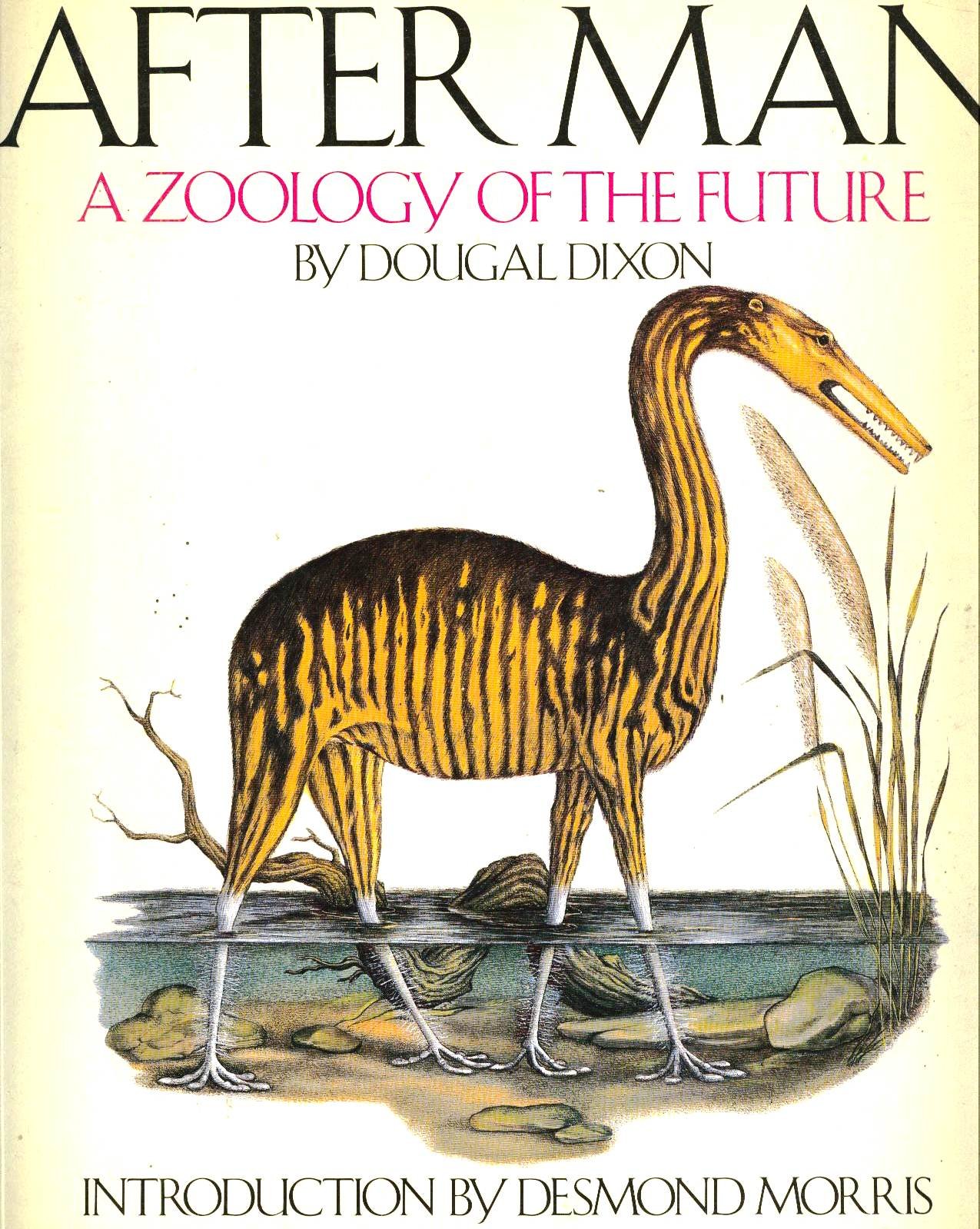
This book imagine Earth about 50 milion years in the future. Humans have gone extinct and so have most big or overly-specialized animals of our days, both because of human activity and natural causes, and explore what has been of the surviving species and what they evolved into. There is also a documentary based on this book, with stop motion bits with the future animals, but was made for Japanese TV and never came to the West. There's footage of it on youtube tho. This is one is probably the easiest to find, since it got a new edition only one or two years ago.
The New Dinosaurs
Same concept as the previous book, but this one imagines a world where the killer asteroid didn't hit Earth at the end of the Cretaceous, and that non-avian dinosaurs kept live on and evolve. At the time it came out was heavily criticized for "forcing" the dinos to evolve into creatures that resembles too much modern bird and mammals, but turns out tha author actually was alot closer to reality than it was thought at the time it came out and some of his "outlandish predictions" actually are true to what we now know of dinosaurs.
Man After Man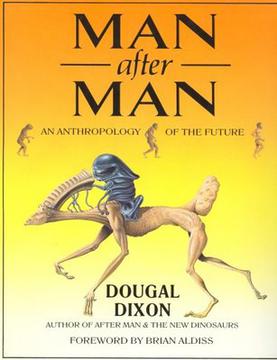
This one is the most grotesque and least grounded in science. It's more or less the same as After Man, except it depicts a world where humans killed almost every other animal and then tried to engineer some new human species that survived in the wild and evolved into into a whole new biosphere. Is weird and creepy as hell, and even the author isn't too fond of it, but it's worth mentioning.
Then there's also...
The Future Is Wild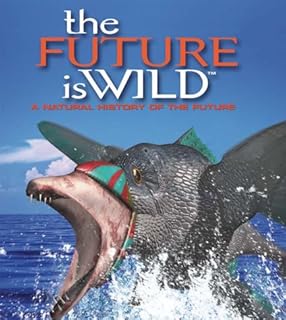
This one is a book + documentaries series that was meant to be a spiritual successor to Dixon's book, but ended up being a true successor, since the man got heavily involved with the project and designed most of the new future lifeforms. It's particularly interesting because it shows the planet in not one, but 3 different moments in time, showing the planet's biosphere getting weirder and weirder as we go into the future.
As for alien speculative biology, Wayne Barlowe is a great starting point. His most famous work is the book called The Expedition that imagines a bunch of automated probest sent from Earth exploring an alien world that is kind of an inbetween Earth and Mars as a general environment, and it's to this day considered one of the most plausible example of speculative alien biology. Sadly it's very very rare, but Discovery Channel a few years ago made a documentary based on it simply called Alien Planet that got a DvD release and it's pretty cheap and easy to find. He also made a couple other books on the argument, but it's all pretty rare to find unfortunately. Oh, and he also designed the alien ecosystem of Pandora for the Avatar movies, and blue cat people aside that is also remarkeably plausibe in terms of alien biology, apparently.
There's a few other illustrated books a whole lot of non-illustrate books and novels, here's a brief list from Wikipedia:
https://spec-evo.fandom.com/wiki/List_of_speculative_evolution_books
Re: Books and Reading
Posted: April 17th, 2019, 1:58 pm
by Raga
Memory, Sorrow, and Thorn Trilogy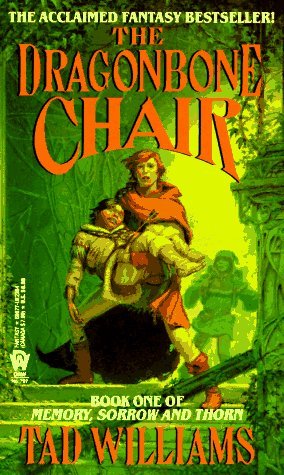


I read these a long time ago as a teenager and I am now rereading them. They are supposedly what inspired George R. R. Martin to write a Game of Thrones (and I happen to like them way better).
They are part of a general evolution in fantasy that went from Tolkien cookie cutters in a more "modern" direction that started in the mid 1990s. This series hasn't degenerated into full on grimdark though and is comfortably halfway between conventional high fantasy and abject nihilism, which I like a lot.
This author is also currently writing a sequel trilogy to this. The first book, The Witchwood Crown, is quite good and the second one, Empire of Grass, comes out this year.
Re: Books and Reading
Posted: April 25th, 2019, 6:31 pm
by Vol
My old copy of Shogun is failing me. I began reading it for the Nth time, but the cover is no longer holding together, the pages are difficult to turn without sticking or curling, and John Blackthorne's romantic adventure requires focus to appreciate, dammit.
I like when my books become worn to the point of failure. They're friends who shared all they could with me. Though now I have to buy a new copy. But before that, going to finally read Tai Pan, another of Clavell's works. Seems like the same sort of story, only China.
Also began reading Mein Kampf as my toilet book, because metaphorical gestures please me, and if you can get through the dry prose, a lot of the theories are verbatim living on today, which is interesting.
Re: Books and Reading
Posted: May 4th, 2019, 9:23 pm
by Joblom
A friend has finally convinced me to start on Dune but I haven't made much progress. Very busy lately.
Re: Books and Reading
Posted: May 6th, 2019, 12:47 am
by Raga
Dune is very weird in a mostly likable way. Just wait until you get to chair dogs.
Re: Books and Reading
Posted: May 9th, 2019, 2:56 am
by Joblom
Raga wrote:Dune is very weird in a mostly likable way. Just wait until you get to chair dogs.
I doubt it can be as weird as some of the stuff I've already read. A Fire Upon the Deep had some real strangeness to it and I've an old book from the my childhood, "Wayne Barlowe's Guide to Extra-terrestrials" which has artist renditions and biology of aliens from many novels and short stories produced in the early 90's and before.
Re: Books and Reading
Posted: May 21st, 2019, 10:00 am
by Raga
Re: Books and Reading
Posted: May 21st, 2019, 12:53 pm
by Sinekein
It is an interesting and argumented read, but I mostly disagree with the point being made. Not in the sense of the show having a successful and satisfying ending arc, but with the weight of supernatural elements in Martin's work and the importance of putting them on the side. Viewers have been lured to GoT by the violent politics and the metaphorical take on Western European history, not by the hidden message behind the Children of the Forest or the White Walkers - indeed, the latter have never been used in any other way than to show spectacular, tense or horrifying scenes while the average GoT scene is very much on the quiet, talkative side.
I agree far more with the article linked within the page, of the show going from sociological to psychological, although I would be less critical as it is extremely hard to treat characters you have written for 60 episodes the same way you do characters written for 10 episodes. The more the series advances, the more their viewers will come to know them and get attached (or not), which means that treating them as simple devices to sociological analysis becomes next to impossible. Indeed, I have seen a fair share of critics pointing out that this character arc or that character arc felt "pointless" or "unfinished" - and combining satisfying, meaningful arcs for every character while also integrating them in a deep psychological analysis is incredibly difficult. Or more accurately, it becomes more and more difficult when the number of characters increases. You can do it on shows where you have 4 or 5 significant characters (The Good Place is a good example), but Game of Thrones has dozen, and I am not even sure Martin will manage to give a satisfying sending to all of them (his character writing is not always on point - see the various Martell kids for that).
Still, D&D did no effort to try and preserve the balance and went for the easy solution. Seasons 5 to 8 felt more "logical" than the first 4, because what happened pretty much was what you would expect from narrative conventions or tropes, while the first four liked to go against those old habits.
I did not read it in its entirety because I do not care for the various religious analyses at the moment, but I will bookmark it. I saw a very interesting analysis of Game of Thrones that mentioned that one of the weakest points of ASoIaF is its treatment of religion, because A) it kinda lacks subtlety like most stories written by (presumably) atheist writers who see religion through the prism of the idiots who abuse it (and since Martin is American, there's no shortage of bible-thumping idiots, and they don't seem on the verge of disappearing at any time) B) it almost entirely ignores the social importance of an organized religion. Aside from the Sparrow, we only see priests and zealots who do not care about the little people (and in the HS's case it's basically used to give him a modicum of ambiguity as to how evil he is, what he means for the little people is never expended upon). Martin's religion is basically only there for burials and sending letters, we almost never see any type of the kind of moral guidance that explains why organized religions are so important even in our "buffered" world.
Religion is also used to artificially distinguish cultures, but it remains superficial, far more than it was in the eras ASoIaF took inspiration from, like the Middle Ages in Western Europe.
Re: Books and Reading
Posted: May 21st, 2019, 5:16 pm
by Raga
Sinekein wrote:It is an interesting and argumented read, but I mostly disagree with the point being made.
I actually don't agree with a lot of it either though not for the same reasons as you. I just thought it was an interesting read.
Raga wrote:I did not read it in its entirety because I do not care for the various religious analyses at the moment, but I will bookmark it. I saw a very interesting analysis of Game of Thrones that mentioned that one of the weakest points of ASoIaF is its treatment of religion, because A) it kinda lacks subtlety like most stories written by (presumably) atheist writers who see religion through the prism of the idiots who abuse it (and since Martin is American, there's no shortage of bible-thumping idiots, and they don't seem on the verge of disappearing at any time) B) it almost entirely ignores the social importance of an organized religion. Aside from the Sparrow, we only see priests and zealots who do not care about the little people (and in the HS's case it's basically used to give him a modicum of ambiguity as to how evil he is, what he means for the little people is never expended upon). Martin's religion is basically only there for burials and sending letters, we almost never see any type of the kind of moral guidance that explains why organized religions are so important even in our "buffered" world.
Religion is also used to artificially distinguish cultures, but it remains superficial, far more than it was in the eras ASoIaF took inspiration from, like the Middle Ages in Western Europe.
Also don't really disagree that he fails (and most fantasy fails) when it tries to deliver on Western, organized religion, which for fantasy purposes usually just means pseudo Catholicism since much of it has a medieval setting. I don't know how far you got in the article but the author talks about the Protestant Reformation and how it served as a segue into rationalism, "disenchantment" as the writer calls it, and ultimately secularism. This is noteworthy because the human impulse this writer is addressing and that successful fantasy at large is addressing is arguably much more primal than anything in modern Protestantism, which is why he keeps mentioning animism and paganism. What most Protestants fail to recognize (and by extension most Anglophone countries because they are descended from a thoroughly Protestant worldview) is that Catholicism/Eastern Orthodoxy is a temporal bridge between three broad epochs: the animistic/paganistic, the monotheistic/theological, and the modern scientific/secular. They only see a demarcation point somewhere circa 1500 AD between "irrational, hidebound theology" and "rational, liberating science" and totally fail to remember that all the pomp, the ritual, the plethora of saints and feast days, the mysticism of transubstantiation and the Trinity that defy both scientific or theological explanation are a bridge between animism/paganism and modern organized religion.
Because of this, they see no contradiction in the position of presenting the High Sparrow as somebody who is mostly there to lord over people, spoil everybody's fun, and police sexuality on nonsensical theological grounds while also writing longingly and reverently about the mystical power and majesty of dragons, touching the mix of dread and awe channeled by Melisandre's fire god, or presenting weirwood trees as an unsettling presence and not just as objects. They want
the numinous and utterly fail to recognize that Catholicism has the numinous in it just as much as weirwood trees do. They turn to animism & paganism in its ancient and modern sense and are capable of engaging with those with something like openness and honesty because they believe those represent something that Catholic style religion killed.
So ASoIaF actually succeeds on
touching the numinous in a paganistic/animistic sense. GRRM gets what makes fantasy fantasy. I can't find it but a great example of that I saw once was his response to some fan who had created an elaborate explanation for the orbit of the planet Westeros is on and how that would account for the weird, long, unpredictable seasons. His response was basically "Dude, it's magic" and by that response he did not mean "Dude, just relax, that's a waste of time. It's just for fun." He meant "You can't quantify this because it isn't scientific. It's supernatural. It's like trying to create an equation for fate or divine intervention." But he does totally fail on "religion" grounds because his modern, Prostestant, secular brain won't let him believe that anything like Catholicism can be about anything but the powers-that-be manipulating the credulous masses to maintain their power mixed with some bizarre terror of human sexuality. "Religion" is what happened to Galileo and Joan of Arc. Nevermind, that Joan of Arc touched something as profound as any aboriginal spirit walker or Buddhist meditator.
Re: Books and Reading
Posted: May 21st, 2019, 7:15 pm
by Sinekein
That is an interesting point, I'll happily admit that religion overall is not something I think about much. Now that you mention it there are a number of "local catholic beliefs", or traditions, that are clearly a mixture of Catholic faith and previous beliefs - Dio de los muertos being maybe the most famous example, but in mountainous areas of Southern France or Northern Spain I know at least of several traditional bear-themed gatherings that have little to nothing to do with what the good book says, and probably predate the evangelization of the region (which was tumultuous for various reasons, including being the seat of the Cathar heresy).
However I wonder if it stands to the test of statistics. I have read a number of fantasy books from non-English speaking authors (I have just started The Witcher), all of which as far as I remember come from countries where catholicism is predominant. But I cannot remember a more subtle take on religion (although it might elude me) from those authors than Martin's - it's just that some or many of their books do not try to look as "socologically accurate" as ASoIaF does when it comes to depicting medieval eras. An example I have in mind is Jean-Philippe Jaworski's Gagner la Guerre (To win the war), which is also a rather grim, political take on fantasy, albeit one in a pseudo-Italian city from the Renaissance instead. And the religion here is no more important or detailed than it is in ASoIaF - even when the hero travels in less technologically-advanced areas. And Jaworski is a French author whom I presume has Polish ancestry, so that's double-Catholicism there. Even in the other fictional universe he has created, which is based on pre-Roma Gaul, there's not much religion (even if the supernatural is present - you have druids, but as far as I remember they are rather close to a Melisandre in that they are there "for the supernatural", not to be a link between the people and forces beyond their grasp.
Come to think of it, the little story bits that link the various stories of the first Witcher book together take place in some kind of Monastery where a benevolent Goddess is worshipped, and we see the High Priestess of the place, along with the other priestesses, alternate freely between the "divine", ie using powers that nonbelievers cannot manipulate, and the "mundane", such as a variety of services that stem from them being literate and knowledgeable, and that surrounding populations rely on. The Priestess is also shown to have a degree of political influence without being a "Rule in the name of the Goddess" kind at all as she clearly displays political acumen when a couple of knights try to intimidate her.
I'll try to think about it when I get on with the books, even though that first one is more about toying with Faerie Tales than it is about building a universe (but apparently the Witcher saga really starts with the third volume).
Re: Books and Reading
Posted: May 22nd, 2019, 12:25 pm
by Raga
Eh, sorry for long rambling WoT. This stuff really stokes my inner nerd.
TLDR Fantasy authors who reduce magic to science or try to replace it with overly clinical historical realism are mostly doing it wrong.
The Witcher books are good and are very much concerned with the fickle, unpredictable nature of the supernatural. The ambiguity of prophecy is a central theme in the Saga. It also generally dabbles with Slavic style animism/paganism because that's where it gets many of its monsters. It treats *some* religion with nuance, like the aforementioned priestess in the first book and it's fairly charitable with druids, who are D&D type ecology/nature priests. However the closest thing to a Catholic style religious order is frequently presented as being full of fanatical racist zealots and they ratchet that up even higher in the games.
When I said "Protestant" I didn't mean to imply that any place that has historically remained Catholic was immune to this process. I just meant it was particularly pronounced in Protestant countries because the Enlightenment and Protestantism are first cousins. But certainly everyplace in Europe has inherited the baggage of the Enlightenment to some degree.
Another thing that's noteworthy is that it's only in the last 30ish years that fantasy started frequently dealing with Catholic style organized religion in the first place and this is a product of an evolution in the genre (specifically in epic fantasy) that took off starting in the late 80s/early 90s. C. S. Lewis, J. R. R. Tolkien, George McDonald and others dealt with the thematic content of Christianity, but not so much with the formal structure and organization of the church. Having an actual church that looks materially like the Catholic or Orthodox church in a fantasy book didn't become a common thing until that shift in the 80s & 90s. The shift I'm talking about is a movement away from a Tolkien style foundation in mythology & folklore with a traditional Hero's Journey/Chosen One type narrative to more of a foundation in historical fiction & political intrigue. This produced several noteworthy differences from earlier Tolkien style fantasy:
1. the "party on quest" framework largely fell away and protagonists became more stationary, hanging out in particular places for entire books or the entire saga
2. the place of demihumans (elves, hobbits, dwarves, orcs, etc.) receded or went away altogether and conflicts between human racial or power groups became more prominent
3. the main characters largely ceased being "the son of a blacksmith" or "a hobbit from the Shire" and became people born into prominence or nobility
4. more focus on historical accuracy and realism, which often means explicitly modeling the setting on some RL historical place and time (like Locke Lamora's home city is heavily Renaissance Venetian or the Lions of Al-Rasson by Guy Gavriel Kay is more or less Moorish Spain)
It's that last one that meant the adoption of something that looks like Catholicism or Islam or Eastern Orthodoxy or whatever. George RR Martin is in a weird place in that he's one of the earlier adopters of this transition so his books retain a lot of the Tolkienish roots of fantasy. However, he isn't among the very earliest (that Memory, Sorrow, and Thorn trilogy I posted earlier was) and those are like half/half hybrids between Tolkien style and something like say Tigana by Guy Gavriel Kay which has more or less completely abandoned Tolkien style. I would actually say the Witcher is exactly halfway between as well, which is why politics and prophecy are equally important and human power struggles matter but so do conflicts between humans and non-humans. Dragon Age is one of these as well.
Anyway, it leaves a lot of modern fantasy in a weird, awkward place where they simultaneously want to downplay the religious themes in early fantasy while also putting forward an actual organized, structured religion in their story of much more prominence than anything Tolkien or C. S. Lewis ever included. So their general skepticism of religion (especially medieval style organized religion) endemic to the modern, Western mind coupled with this desire to make the plot focus on power struggles and political intrigue naturally inclines them to focus on stuff like the Inquisition while completely abandoning things like Joan of Arc's visions, or the healing power of reliquaries, or the intervention of saints in RL and so on. Meanwhile, the good writers still do realize they are writing fantasy and not historical fiction and they need, you know, *magic* to make it work. So they turn to those aspects of "magic" they find most tolerable and mine animism/paganism.
The older stuff tends to come off more organic (to me anyway) because Tolkien type authors might have been Christians but they were looking for the spiritual commonalities in *all* traditions and also in the human experience generally. They were concerned with the experience and phenomenon of "magic" itself in whatever guise it might take. C. S. Lewis' autobiography "Surprised by Joy" frames his whole life and conversion to Christianity as experiences with what he calls "Joy," which he describes as experiences of profound transcendental Otherworldliness (so magic basically). He gets this in equal measure from Norse mythology and the story of the Resurrection of Christ. That enable authors like him to thematically mine many seemingly contradictory traditions for content and blend them together into something with no real basis in any RL thing but that is still immensely relatable and meaningful. For them, there was no on/off switch between Welsh folktales or the resurrection of Christ or Jewish mysticism or whatever so the juxtaposition of omnipresent overseer gods with magical constructs like golems made by mage "scientists" and fairies stealing children or whatever was in no way contradictory or at odds.
The best modern fantasy still does this, just with more historical realism and less archetypal characters.
Re: Books and Reading
Posted: May 22nd, 2019, 12:38 pm
by Raga
Oh, by the way, if you have recommendations for non-English fantasy I'd actually love to get those. I can figure out if they have translations myself. This is something I've intentionally wanted to dig into more in the last few years, but it's really hard to find stuff because the American book world is really blinkered for the most part, especially with genre fiction. The only thing I can think of that has any penetration here at all is like Nordic style dark, gritty mystery series like The Girl with the Dragon Tattoo.
A couple I've heard of and have meant to check out are Pierre Pevel and Maryna Dyachenko but I have no idea if they are any good.
Re: Books and Reading
Posted: May 22nd, 2019, 1:21 pm
by Sinekein
I have not read that many French fantasy, in part due to the predominance of English-speaking authors, and because the genre here also had to "fight" with the Bande Dessinée - French-Belgian comics in which fantasy is far, far more prominent than it is in US Comic books.
Still, the names that spring to mind are:
- Pierre Pevel (I read Les Lames du Cardinal, I don't have that many memories of it as it was a while ago, but those I have are positive)
- Jean-Philippe Jaworski (Magnum Opus is clearly Gagner la Guerre, but you also have the Janua Vera novels set in the same universe, and the Gaul-themed anthology starting with Même pas mort). I doubt he has been translated not because he isn't successful, but because translating him is going to be a gigantic headscratcher as he was a specialist of modern French language, and adores the slang called "argot" - to the point that I had to use a dictionary at points to understand what the characters meant
- Henri Loevenbruck wrote the Moïra cycle, also Gaul/Druid themed, it kinda reminded me of Marion Zimmer Bradley
- Pierre Grimbert wrote the series called Le Secret de Ji, I have fond memories of it but I read it when I was about 17. Apparently the sequel (Les Enfants de Ji) is really bad.
And if you want to try out some comics in the genre (I am more knowledgeable there to be honest), I can mention:
- La Quête de l'Oiseau du Temps by Régis Loisel, which is hugely influential (the same Loisel also drew a magnificent and super dark adaptation of Peter Pan)
- Le Grand Pouvoir du Chninkel, by Rosinsky and Van Hamme, another classic
- The entire Thorgal cycle from the same authors, which stars the eponymous Thorgal, a viking orphan going on to live incredible adventures. This one is a long-runner, 35+ tomes plus three spin-off series centered around his daugher Louve, his son Jolan, and his lover/archenemy Kriss de Valnor. Still, books #9 to #13 (Les Archers to Entre Terre et Lumière) are ridiculously good - that's where the aforementioned Kriss is introduced.
- Lanfeust de Troy, by Christophe Arleston and Didier Tarquin, is another universe that spawned countless sequels and spin-offs. It's set in the world of Troy where everyone has one power, which can range from deadly to pathetic. It mixes dumb, Apatow-like humor with very graphic violence and a metric ton of pop-culture references, and is better than the sum of its parts. Its sequel, Lanfeust des Etoiles, is a space opera. And its second sequel, Lanfeust Odyssey, comes back to the heroic fantasy.
- Garulfo, by Alain Ayroles & Bruno Maïorama, which affectionately parodies fairy tales, the eponymous character being a frog that gets turned into a human, and meets knights, ogres and princesses.
- De Cape et de Crocs, by Alain Ayroles and Jean-Luc Masbou, which this time parodies Cloak and dagger stories, except the main two characters are an anthropomorphic fox and an anthropomorphic wolf. It is full of poetry and homages to French literature classics - one of the characters being for example Cyrano de Bergerac.
Re: Books and Reading
Posted: May 31st, 2019, 8:23 pm
by Raga